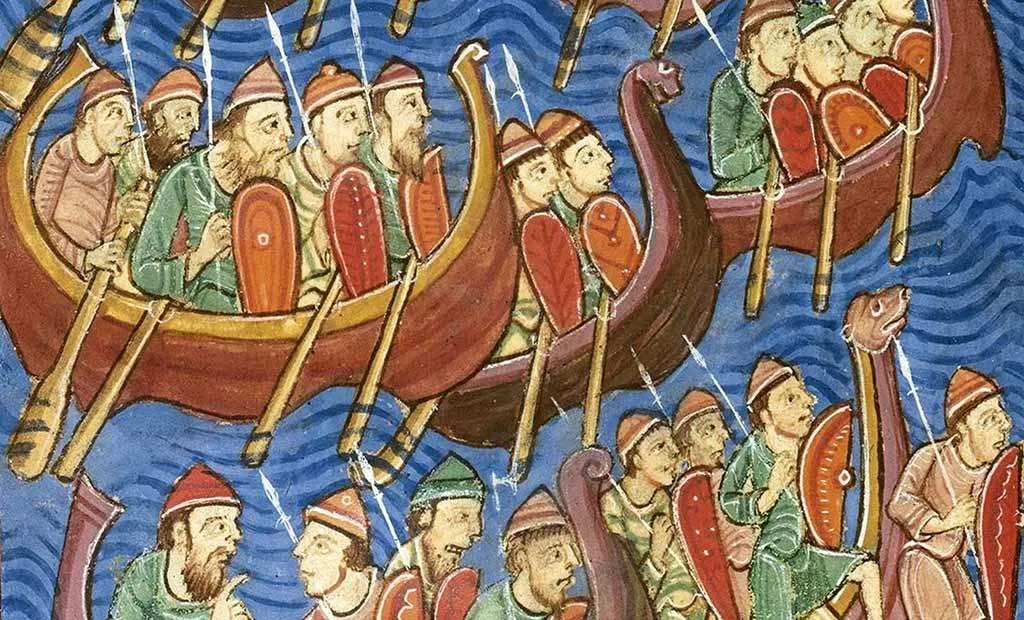
Today, more than 1,200 years ago, the Lindisfarne monastery, located off the coast of Northumbria in what is now northern England, was attacked by Norse raiders. While not the first encounter between Norse raiders and the English, this raid is widely regarded by scholars as marking the beginning of the Viking Age in mainland Europe.
According to the Anglo-Saxon Chronicle, recorded years later, the year 793 began with “ill portents”: “immense whirlwinds, flashes of lightning, and fiery dragons were seen flying in the air.” The monks reportedly sensed that something terrible would occur that year, though no one could predict its form.
Lindisfarne, meaning “holy isle,” was a significant religious site where the remains of Saint Cuthbert were laid to rest. Many English people at the time believed the Norse raiders were a divine scourge, sent by God to punish them for their sinful lifestyles. The scholar Alcuin of York speculated that Lindisfarne’s troubles stemmed, in part, from the monastery’s controversial decision to allow the burial of Sicga, a noble who committed suicide in 793 after murdering King Ælfwald of Northumbria in 788. Suicide was a grave sin in early medieval Christianity, and such a burial would have been seen as a violation of religious norms. Alcuin also suggested that the English should cut their hair, as God disapproved of long hair, to ward off such attacks. (Sounds effective)
The term “Viking” is often misused today. It does not refer to a people or culture but to an occupation—specifically, a raider or pirate in Old Norse. To “go a-viking” meant to embark on a raiding expedition. This misunderstanding likely arose when the English asked the raiders who they were, and they replied “Vikings,” which was misinterpreted as the name of their culture. Such misunderstandings were common in conversations across language barriers.
Most Norse men were farmers, though all were proficient with weapons. Ecological pressures drove many to raid. Northern lands were always challenging for agriculture, but a series of volcanic eruptions around 536 caused a dramatic climate shift, making survival even harder. Centuries later, as regions now known as Sweden and Norway grew colder and crops failed, more Norse men turned to raiding, seeking gold, riches, and, most importantly, fertile land to sustain their communities. The Viking raids, beginning with Lindisfarne, indirectly contributed to England’s unification. The need to fend off these attacks forced rival Anglo-Saxon kingdoms to cooperate, eventually transforming a patchwork of small, squabbling fiefdoms into a unified England, a process traceable back to those climatic disruptions 1,500 years ago.
History is not merely a list of names and dates. Properly understood, it is an interconnected web of actions, reactions, and tangles—a living, breathing mess that continues to evolve today.


 Temple of Athena the Savior
Leave a reply to ganglerisgrove Cancel reply