Star Trek for Pagans: Janeway’s Shamanic Journey

It’s been quite a while since I’ve worked on a “Star Trek for Pagans” essay, or anything really, so bear with me as I dive into one of Voyager’s spiritual treasures: the Season 3 episode “Sacred Ground.” I know Voyager gets flak from some Star Trek fans, and while it does have some production issues, that’s beyond the scope of this essay. I quite enjoy Voyager, and it will always have a place in my heart. This episode, in particular, is in my top ten for its profound exploration of Captain Janeway’s spiritual journey. The alien characters in this episode are never given names—they are always called the Magistrate, the Guide, or the Elders. I didn’t notice this until recently, but this small detail keeps the Nechani characters from becoming fully realized people and elevates them into the realm of Myth and Story. “Sacred Ground” confronts the tension between science and faith, especially in a technologically advanced culture. Chakotay has a few good lines, but he feels oddly underused in this episode. With his background, you’d think he’d have a much bigger role.

The episode opens with the Voyager crew on shore leave, touring a Nechani monastery, a sacred site led by the Magistrate (Harry Groener, Buffy’s Mayor in a more benevolent role—I promise he’s not going to eat anybody!). Kes, possibly drawn by her Ocampa psychic gifts, wanders to a shrine and triggers an energy field, collapsing into a coma. The Magistrate, embodying the archetype of the Wise Elder, explains that Kes is being “punished” by the Ancestral Spirits. He insists that they leave immediately, before they can cause further offense. Later, when it becomes clear that the Doctor is unsuccessful in treating Kes, Neelix manages to dig through the Nechani’s archives, finding a myth which told the story of King Nevid saving his son through a ritual. I’m a future meeting with the Magistrate, Janeway cited the story as precedent, and as Kes’s captain, she could claim responsibility for her and plead for her life.

The unnamed Magistrate and Guide elevate the story to a mythic realm, their lack of personal names evoking timeless figures like Hera testing Jason as an old woman or Odin wandering in disguise in Norse tales. For Pagans, this anonymity signals archetypes—guardians and mentors who guide heroes through transformation. Janeway’s ritual, led by the unassuming Guide, is a shamanic odyssey that challenges her scientific core. Initially mistaking the Guide for a maintenance worker, Janeway learns humility, a trope straight out of myth—think Zeus and Hermes as beggars testing Phrygian hospitality. The Guide, a Shaman archetype, speaks in riddles, leading Janeway through trials: holding a glowing stone, painting a canvas, climbing a cave in a vision, and facing a snake-like “nesset.” Each mirrors shamanic initiations across cultures. The stone-holding evokes Norse rune-seeking, where endurance and physical trials unlocks wisdom. The “nesset” recalls Egyptian serpent Deities like Wadjet, protectors of the soul. The painting, where Janeway notes her sister was the artist while she was the scientist, hints at her struggle to embrace intuition over logic, a theme the Guide amplifies: “Mathematics… The answer’s either right or wrong. It’s very absolute.”

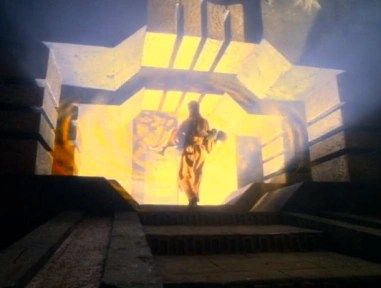
The ritual’s climax is Janeway’s “death” in a sensory deprivation chamber, a coffin-like space where she moans, “I’m dying.” The Guide’s responses in a calm, serene tone that “Everyone dies eventually”, smiling as she closes the lid on Janeway. This pushes her to surrender control, a pivotal shamanic moment. This scene can be compared to many “surrender” moments in myth, such as Odin’s sacrifice on Yggdrasil, where he hangs for nine days and nine nights to win the Runes. There is always the moment of surrender and death, when you step from what was into what will be. The details are inconsequential, but mystics the world over speak the same language— and apparently, on many worlds. Janeway’s trials and symbolic descent to the underworld, her vision abruptly changing to a bright, rocky shore, where Janeway converses with the Ancestral Spirits via the Guide; All of this would be recognizable to anyone with even a passing familiarity with Paganism or with shamanistic cultures. When Janeway pleads for Kes, citing King Nevid, the Guide reveals, “You have what you need to save her yourself,” shifting the power to her faith. This “death” and vision strip away her scientific lens, forcing her to trust the unquantifiable—a transformative leap for a Starfleet captain.
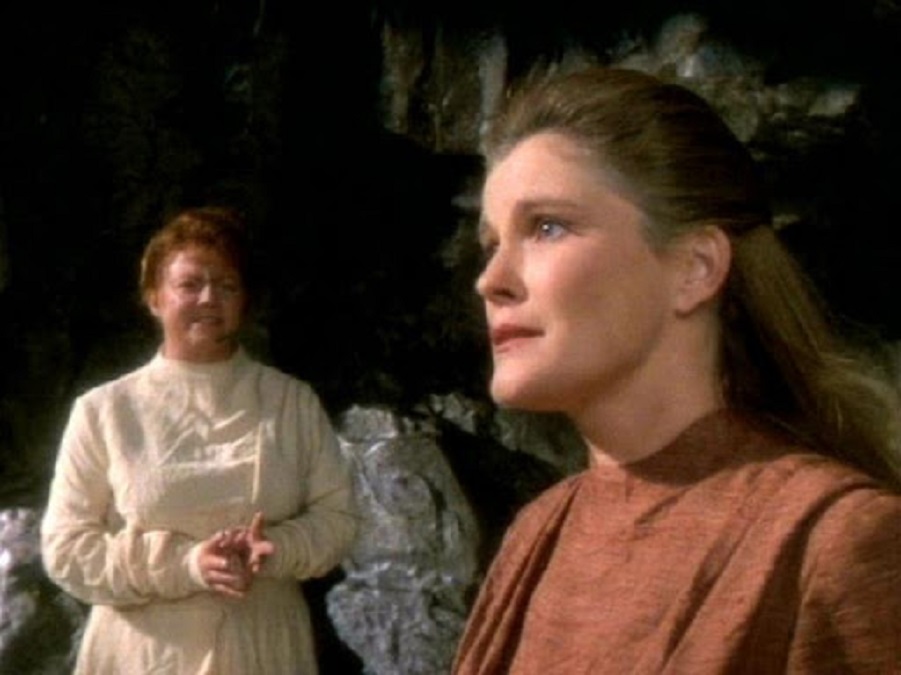
Chakotay’s spiritual perspective, rooted in his Native American heritage, should have been a cornerstone but feels oddly sidelined. In Season 1’s “The Cloud,” he introduced Janeway to a vision quest, guiding her to her spirit guide (a gecko) via a medicine wheel, establishing their role as a spiritual mentor. Yet in “Sacred Ground,” he spent much of the episode arguing with the Doctor and Tuvok to beam Janeway back to ship, worried about her faltering vital signs. This pragmatic stance jars with his vision quest experience, where he embraced the mystical. Repeatedly in Voyager Chakotay is willing to defer to tradition, even in dangerous circumstances. Allowing Vorik and B’Elanna to fight, supposedly to the death, when overcome with pon farr and cut off from the ship, comes to mind. Tuvok only had to appeal to “tradition,” and Chakotay allowed it. But in this case, despite his experience with ritualistic vision quests, he argued against it. Perhaps it’s meant to show how much he cared for Janeway and felt powerless. Still, it seems out of character.

When Janeway insists, “If we scratch deep enough, we’d find a scientific basis for most religious doctrines,” Chakotay counters, “I remember when my mother taught me the science underlying the vision quest… Some of the mystery was gone.” His insight about preserving mystery is profound, but the episode underused Him. He could have recognized the chamber as a liminal space akin to his own rituals, guiding Janeway to see the Spirits as akin to his animal guide. Imagine Chakotay helping her interpret the vision, framing her “death” as a rebirth, bridging her skepticism with the Nechani’s faith. His absence as a mentor is a missed opportunity, diminishing the episode’s spiritual depth.The faith-reason tension drives the narrative, framed by archetypal symbols. Janeway’s early attempts to analyze the shrine’s energy field reflect her scientific bias, but the Guide’s riddles—“If you can explain everything, what’s left to believe in?”—challenge her to embrace mystery. The “nesset” and chamber evoke Egyptian underworld journeys, where serpents and confinement lead to renewal. The nesset’s bite leaves three marks on her arm, instead of two fangs. This may have been to appear more “alien,” but threes and multiples of three are incredibly sacred numbers in many Pagan religions. There are so many layers of symbols in the entire episode. But all the challenges, all the symbols, are ultimately meaningless, as she is repeatedly told. All that matters is finding her own connection to the Spirits: surrender and faith. The rocky shore vision, a liminal space between land and sea, recalls Greek myths like Odysseus’s underworld visit, where divine encounters spark transformation. These symbols resonate with pagans, who see the sacred in such thresholds.

The episode’s resolution, where Janeway saves Kes through faith, is powerful… She can barely stand, but she’s filled with purpose. When Janeway gathers up the comatose Kes to walk into the shrine, entering the field—faith will save her, but doubt will kill them both—as Neelix and Chakotay fearfully look on, Kes wakes up. Janeway, the scientist and explorer, took a leap of faith, and the maiden awoke.
In the last scene of the episode, once again aboard Voyager, the Doctor excitedly explains the recovery with science. But Janeway sits with her hands folded in her lap, her expression distant — beautifully acted by Kate Mulgrew—suggests disappointment, echoing Chakotay’s warning about losing mystery. In this moment, I believe that for the first time, the scientific explanation was not enough for her. While she describes the Doctor’s explanation as “perfectly sound,” it could not capture the ineffable force of her first spiritual experience. A few seasons later Janeway will guide of Seven of Nine in “The Omega Particle,” where she acknowledges Seven’s own spiritual awakening, likely recalling this moment. “Sacred Ground” crafts a timelessness myth through its unnamed Nechani archetypes. The Magistrate, a guardian of sacred boundaries, and the Guide, a Shaman navigating the divine, evoke seers and Oracles. For Pagans and Star Trek fans, the episode is a powerful reminder that faith and transformation endure, even in a scientific future. Chakotay’s sidelined role, despite his voice normally being the one speaking in favor of spirituality, highlights a missed chance to deepen Janeway’s journey. Yet, the Nechani’s mythic framework invites us to embrace the unknown, where the mysteries of the soul—whether in a starship or a sacred cave—continue to shine.

14 responses to “Star Trek for Pagans: Janeway’s Shamanic Journey”

  1. ganglerisgrove Avatar
    ganglerisgrove

    Janeway was so irritating in this episode. Granted, she’s my least favorite captain — though Archer is close in the running for that (he has no consistent ethics whatsoever .My favorite is Sisko). she’s a good model for the typical modern though: they will refuse to see what’s right in front of them even when it’s crucial they do so, until they have no other choice, no matter how much pain and suffering it causes because paradigms are hard. and believing in pretty much anything else is easier than acknowledging the Powers that are higher than we on the cosmic totem pole.

    1. I did look up to Janeway when Voyager first came out – but I was like 10. 😅 Chakotay could have had such a more interesting part in this episode. I feel like the Doctor should have argued to beam her back and Chakotay could have been against it, idk. There could have been a lot more they could have done.

      the best explorations of spirituality in Star Trek usually come through the non-human characters. But yes, the Sisko will one day get his entire, much longer, essay. It’ll probably have to be broken into several posts.

      One of Archer’s problems was that the writing of the show completely changed because 9/11 happened while it was airing, and then media had to grapple with that as the nation was reeling. I do think that without a higher power, ethics are a much more nebulous concept for many. It’s not atheists CAN’T be good people, it’s just that it’s so much easier to become unmoored in times of stress without something to anchor yourself to. … I don’t know if articulated what I am trying to say very well there.

      1. ganglerisgrove Avatar
        ganglerisgrove

        I think the problem with “Enterprise” was that it turned into Quantum Leap in space. Also, the general contempt with which all the Star Trek series treat religion is an ongoing problem for me…I get what you’re saying there. You’re making sense.

        but Archer was poorly written, too emotional and inconsistent to be a captain. DS9 was the most spiritually interesting of the shows, and Sisko was my favorite captain because he could be hard core and brutal when he had to be, even if it wasn’t his first choice. His son is annoying as hell and I like literally no one else in the series except Garak, but Sisko sells it for me.

      2. Archer did get angry a lot. I think they were trying to contrast him with T’pol, but it came off as immature. In TOS that dynamic worked better because McCoy wasn’t in command, he was the Doctor, and Kirk was wrangling the two. But I may be giving the show too much credit. I liked Hoshi, even if the show sidelined her a lot.

        DS9 is 100 percent my favorite of the shows, I like Voyager mostly for B’lanna and Seven’s stories. Sisko’s journey is the BEST, Kira’s faith, oh there’s just sooooo much to explore. And Garak is quite literally That Bitch, you gotcha love him.

        You’re right that Star Trek tends to treat religion with contempt, in general, but it’s something that I grew up with and will always love. Even when Roddenberry didn’t want to have it in his future, these stories crept in because it’s an essential part of our existence.

      3. Star Trek tends to treat religion with contempt, unlike Babylon 5 and Battlestar: Galactica. Although…there’s a Strange New Worlds episode where Pike talks about the religion on a planet that Earth had colonized; he mentions Wicca and a bunch of other faiths, with no judgment. (Maybe because Pike’s father was supposed to have been a professor of comparative theology.)

      4. Its been a while since I’ve rewatched it, but Babylon 5 is excellent. 👌 At some point I will have to write about that as well, most likely. My love of sci-fi, fantasy, and religion may end up with all these ramblings in a book of essays eventually. I’d also love to tackle Avatar: the last Airbender. Not the new live action, obviously.

        Yessss I love Pike on Strange New Worlds. On pins and needles waiting for the new season! Omg poor La’an, that cliffhanger!! 😭😭😭😭

        Hey, is your name Vala because of the character on SG-1?

      5. ganglerisgrove Avatar
        ganglerisgrove

        You wrote ” Its been a while since I’ve rewatched it, but Babylon 5 is excellent. 👌 At some point I will have to write about that as well, most likely. My love of sci-fi, fantasy, and religion may end up with all these ramblings in a book of essays eventually. I’d also love to tackle Avatar: the last Airbender. Not the new live action, obviously.”

        I would read that book. I hope you do write it. Keep an eye out, btw, on popculturetheology.com. They post academic CFPs on various shows and topics and often they include Sci Fi and horror.

        I loved the animated series TLA — (my only complaint was that they left villains alive but it was on Nikolodeon, I think? so it makes sense). It was an excellent representation of animism. I was kind of blown away to see something so popular be decent in that respect!

        You wrote, “Yessss I love Pike on Strange New Worlds. On pins and needles waiting for the new season! Omg poor La’an, that cliffhanger!!”

        I couldn’t stand Discovery and just pretend it doesn’t exist, but Pike is so well cast. (and can I just say: the doctor and Chapel with space-meth that lets them berserk. this was awesome lol). I’ve been waiting also for the new season. I know the writer’s strike pushed it back but omg, when when when is it coming back? I thought it was supposed to be out this mos. can’t wait. 🙂

      6. I really preferred the animism on Last Airbender to the Korra sequel, which ended up going for a duelist Zoroastrianism type origin. Meh. Also there was too much romance in Korra, and I didn’t care. I don’t mind those plots and sometimes I watch more shippy stuff. But that wasn’t what I watched Avatar for. The spiritual plots were what I was there for! I actually didn’t mind that they left villains alive. The characters were 12 years old, for one thing, lol. It was also more tortuous for Ozai to live without powers, as a normal person, in jail. He’d rather force Aang to betray his principals and kill him, and have some satisfaction in that. But finding a third way that no one else sees is such an Air Element trait, it’s too perfect.

        But I think some of the differences between us is that archetypically, you’re much more Warrior energy, and I’m more Healer. We’re going to see the world differently. But that’s okay, we both have our roles to support the survival of our tribe!

        I’ve had this project at the back of my mind for a while. I’ll probably have a few essays about ghibli animism is well.

      7. ganglerisgrove Avatar
        ganglerisgrove

        I liked the original animated series too — never saw Korra. I do dislike it when romance is included in what to me are action stories, but it didn’t bother me too much in the original last Airbender.

        I just think it’s tactically stupid to leave villains alive. always put your opponent on the field of battle down. first. save the speeches for after. lol. but make sure they can’t get up again. ever. I get it though: it’s a TV show and was aired, iirc (I saw it much later in a boxed set of dvd) for kids.

    2. Archer was worse than Janeway, in my opinion. His refusal to share the cure for a planet’s plague led to the death of an intelligent species in ‘Dear Doctor’…this was before the Prime Directive existed, so there was no reason to do this. Then in ‘Similitude’ he arranges for the birth — and death — of an intelligent being so that its tissue could be harvested to save the life of one of his officers. Those are both pretty low, and dare I say it, dishonorable. Janeway, on the other hand, made a terrible decision when she basically had Tuvix murdered to bring back the two crewmen who’d merged to create him. At that point in time, Tuvok and Neelix were basically dead. They no longer existed. But Tuvix did; he was there in the then and now and did not exist just as some sort of potential lifeform(s). In my mind, I’m reminded of the “possession is nine tenths of the law” idea…who is in possession of this life force right now? Tuvix is, Tuvok and Neelix weren’t. In my opinion, Janeway ordering Tuvix to be basically dragged off to his death while begging to be allowed to live was not just dishonorable, but immoral.

      And yeah. Sisko was best.

      1. ganglerisgrove Avatar
        ganglerisgrove

        yeah, ethically Archer was the worst of the two.

        Re. tuvix. her responsibility was to her crew members, not this abomination accidentally created. What she should have done was put him in cryostasis until a cure could be found. We watched that particular episode on a theology tv night at school and I couldn’t contain my absolute revulsion at Tuvix nor the way this thing manipulated those Tuvok and Neelix knew (whom I find irritating to say the least on a good day — one of the reasons I disliked Voyager, though at least he’s generally useful, if annoying). if Tuvix couldn’t be fixed, and the two beings of which he was made separated (because it was also Tuvok’s family involved not to mention her oaths to care for the well being of her crew), I’d have put him down without hesitation. I have extremely strong feelings about that particular episode.

  2. Yeah people always seem to forget that Tuvok has a wife and four children back on Vulcan. The Tuvix episode is particularly rough, especially on poor Kes. There’s been transporter accidents where duplicates were made, re: Thomas Riker. I don’t see why they couldn’t have used the transporter to essentially clone Tuvix AND let Neelix and Tuvok live. Then they would have a third character and with Neelix’s jealousy issues that might not work having Tuvix around wanting to be all creepy around Kes, but … Ethically that seemed like the best option.

    And I had completely forgotten about Sim! Dang that was a dark one. Beautifully acted by Conner Trinneer, though. Okay, yeah, Archer is the worst. It’s official.

  3. ganglerisgrove Avatar
    ganglerisgrove

    Yeah, no matter how much I complain, it’s something I grew up with and I will always love it too. I actually really like the new Pike series.

    “Garak is THAT Bitch” *G* yep. You know the writers wanted to make him bi and have him and dr. basher in a relationship but producers flipped and killed it. grrr.

    I don’t usually read fan fiction, but THE bet piece I ever read, bar none (so good I wish it could have been its own novella) was set in DS9 (no smut — not that I have anything against smut *G* but this one just was a story).

  4. ganglerisgrove Avatar
    ganglerisgrove

    I LOVE Bab. 5, btw. absolutely love it. I’ve never been able to get into the reboot of the B. Galactica series but maybe will give it another shot.

Leave a reply to templeofathena Cancel reply