It’s been quite a while since I’ve worked on a “Star Trek for Pagans” essay, or anything really, so bear with me as I dive into one of Voyager’s spiritual treasures: the Season 3 episode “Sacred Ground.” I know Voyager gets flak from some Star Trek fans, and while it does have some production issues, that’s beyond the scope of this essay. I quite enjoy Voyager, and it will always have a place in my heart. This episode, in particular, is in my top ten for its profound exploration of Captain Janeway’s spiritual journey. The alien characters in this episode are never given names—they are always called the Magistrate, the Guide, or the Elders. I didn’t notice this until recently, but this small detail keeps the Nechani characters from becoming fully realized people and elevates them into the realm of Myth and Story. “Sacred Ground” confronts the tension between science and faith, especially in a technologically advanced culture. Chakotay has a few good lines, but he feels oddly underused in this episode. With his background, you’d think he’d have a much bigger role.
The episode opens with the Voyager crew on shore leave, touring a Nechani monastery, a sacred site led by the Magistrate (Harry Groener, Buffy’s Mayor in a more benevolent role—I promise he’s not going to eat anybody!). Kes, possibly drawn by her Ocampa psychic gifts, wanders to a shrine and triggers an energy field, collapsing into a coma. The Magistrate, embodying the archetype of the Wise Elder, explains that Kes is being “punished” by the Ancestral Spirits. He insists that they leave immediately, before they can cause further offense. Later, when it becomes clear that the Doctor is unsuccessful in treating Kes, Neelix manages to dig through the Nechani’s archives, finding a myth which told the story of King Nevid saving his son through a ritual. I’m a future meeting with the Magistrate, Janeway cited the story as precedent, and as Kes’s captain, she could claim responsibility for her and plead for her life.
The unnamed Magistrate and Guide elevate the story to a mythic realm, their lack of personal names evoking timeless figures like Hera testing Jason as an old woman or Odin wandering in disguise in Norse tales. For Pagans, this anonymity signals archetypes—guardians and mentors who guide heroes through transformation. Janeway’s ritual, led by the unassuming Guide, is a shamanic odyssey that challenges her scientific core. Initially mistaking the Guide for a maintenance worker, Janeway learns humility, a trope straight out of myth—think Zeus and Hermes as beggars testing Phrygian hospitality. The Guide, a Shaman archetype, speaks in riddles, leading Janeway through trials: holding a glowing stone, painting a canvas, climbing a cave in a vision, and facing a snake-like “nesset.” Each mirrors shamanic initiations across cultures. The stone-holding evokes Norse rune-seeking, where endurance and physical trials unlocks wisdom. The “nesset” recalls Egyptian serpent Deities like Wadjet, protectors of the soul. The painting, where Janeway notes her sister was the artist while she was the scientist, hints at her struggle to embrace intuition over logic, a theme the Guide amplifies: “Mathematics… The answer’s either right or wrong. It’s very absolute.”

The ritual’s climax is Janeway’s “death” in a sensory deprivation chamber, a coffin-like space where she moans, “I’m dying.” The Guide’s responses in a calm, serene tone that “Everyone dies eventually”, smiling as she closes the lid on Janeway. This pushes her to surrender control, a pivotal shamanic moment. This scene can be compared to many “surrender” moments in myth, such as Odin’s sacrifice on Yggdrasil, where he hangs for nine days and nine nights to win the Runes. There is always the moment of surrender and death, when you step from what was into what will be. The details are inconsequential, but mystics the world over speak the same language— and apparently, on many worlds. Janeway’s trials and symbolic descent to the underworld, her vision abruptly changing to a bright, rocky shore, where Janeway converses with the Ancestral Spirits via the Guide; All of this would be recognizable to anyone with even a passing familiarity with Paganism or with shamanistic cultures. When Janeway pleads for Kes, citing King Nevid, the Guide reveals, “You have what you need to save her yourself,” shifting the power to her faith. This “death” and vision strip away her scientific lens, forcing her to trust the unquantifiable—a transformative leap for a Starfleet captain.
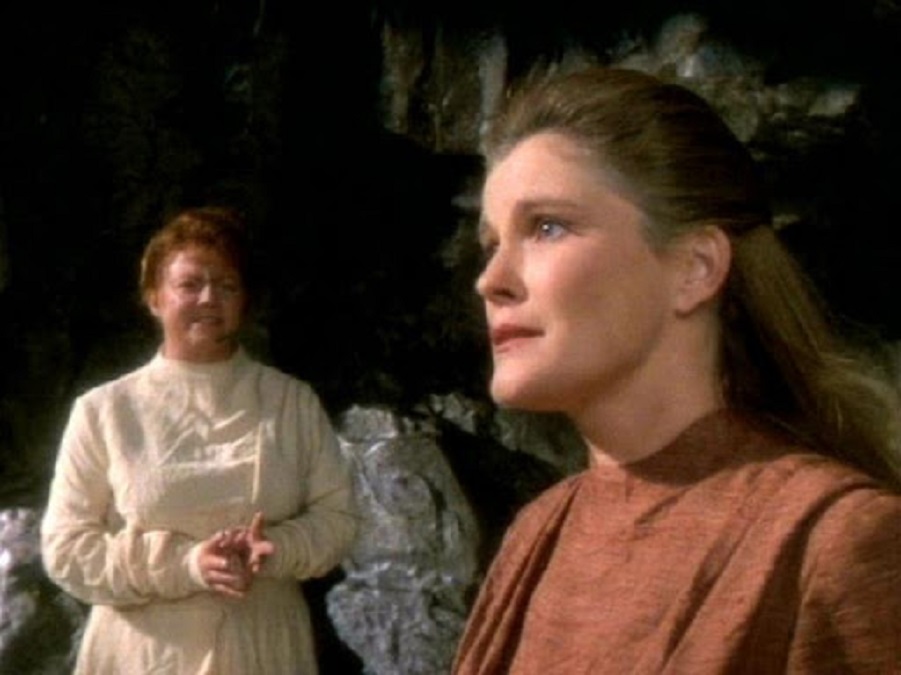
Chakotay’s spiritual perspective, rooted in his Native American heritage, should have been a cornerstone but feels oddly sidelined. In Season 1’s “The Cloud,” he introduced Janeway to a vision quest, guiding her to her spirit guide (a gecko) via a medicine wheel, establishing their role as a spiritual mentor. Yet in “Sacred Ground,” he spent much of the episode arguing with the Doctor and Tuvok to beam Janeway back to ship, worried about her faltering vital signs. This pragmatic stance jars with his vision quest experience, where he embraced the mystical. Repeatedly in Voyager Chakotay is willing to defer to tradition, even in dangerous circumstances. Allowing Vorik and B’Elanna to fight, supposedly to the death, when overcome with pon farr and cut off from the ship, comes to mind. Tuvok only had to appeal to “tradition,” and Chakotay allowed it. But in this case, despite his experience with ritualistic vision quests, he argued against it. Perhaps it’s meant to show how much he cared for Janeway and felt powerless. Still, it seems out of character.
When Janeway insists, “If we scratch deep enough, we’d find a scientific basis for most religious doctrines,” Chakotay counters, “I remember when my mother taught me the science underlying the vision quest… Some of the mystery was gone.” His insight about preserving mystery is profound, but the episode underused Him. He could have recognized the chamber as a liminal space akin to his own rituals, guiding Janeway to see the Spirits as akin to his animal guide. Imagine Chakotay helping her interpret the vision, framing her “death” as a rebirth, bridging her skepticism with the Nechani’s faith. His absence as a mentor is a missed opportunity, diminishing the episode’s spiritual depth.The faith-reason tension drives the narrative, framed by archetypal symbols. Janeway’s early attempts to analyze the shrine’s energy field reflect her scientific bias, but the Guide’s riddles—“If you can explain everything, what’s left to believe in?”—challenge her to embrace mystery. The “nesset” and chamber evoke Egyptian underworld journeys, where serpents and confinement lead to renewal. The nesset’s bite leaves three marks on her arm, instead of two fangs. This may have been to appear more “alien,” but threes and multiples of three are incredibly sacred numbers in many Pagan religions. There are so many layers of symbols in the entire episode. But all the challenges, all the symbols, are ultimately meaningless, as she is repeatedly told. All that matters is finding her own connection to the Spirits: surrender and faith. The rocky shore vision, a liminal space between land and sea, recalls Greek myths like Odysseus’s underworld visit, where divine encounters spark transformation. These symbols resonate with pagans, who see the sacred in such thresholds.

The episode’s resolution, where Janeway saves Kes through faith, is powerful… She can barely stand, but she’s filled with purpose. When Janeway gathers up the comatose Kes to walk into the shrine, entering the field—faith will save her, but doubt will kill them both—as Neelix and Chakotay fearfully look on, Kes wakes up. Janeway, the scientist and explorer, took a leap of faith, and the maiden awoke.
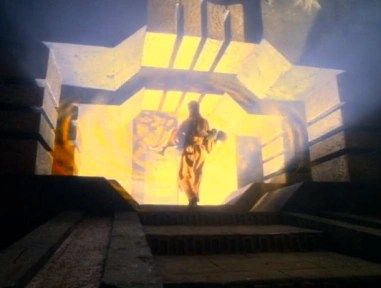
In the last scene of the episode, once again aboard Voyager, the Doctor excitedly explains the recovery with science. But Janeway sits with her hands folded in her lap, her expression distant — beautifully acted by Kate Mulgrew—suggests disappointment, echoing Chakotay’s warning about losing mystery. In this moment, I believe that for the first time, the scientific explanation was not enough for her. While she describes the Doctor’s explanation as “perfectly sound,” it could not capture the ineffable force of her first spiritual experience. A few seasons later Janeway will guide of Seven of Nine in “The Omega Particle,” where she acknowledges Seven’s own spiritual awakening, likely recalling this moment. “Sacred Ground” crafts a timelessness myth through its unnamed Nechani archetypes. The Magistrate, a guardian of sacred boundaries, and the Guide, a Shaman navigating the divine, evoke seers and Oracles. For Pagans and Star Trek fans, the episode is a powerful reminder that faith and transformation endure, even in a scientific future. Chakotay’s sidelined role, despite his voice normally being the one speaking in favor of spirituality, highlights a missed chance to deepen Janeway’s journey. Yet, the Nechani’s mythic framework invites us to embrace the unknown, where the mysteries of the soul—whether in a starship or a sacred cave—continue to shine.


 Temple of Athena the Savior
Leave a comment